Overview
Agentic systems add sub-agents to improve answers. Each extra call costs computation and can leave the answer unchanged or turn a correct answer into a wrong one. Existing selective methods decide from query features, team structure or model confidence; none compares committing against delegating from the same reasoning state. The paper asks when additional intelligence is worth it.
MARGENT uses a trainable manager that writes the candidate it would submit now, then commits or delegates to one of three frozen sub-agents (Extractor, Reasoner, Verifier), revises the candidate from the returned signal and decides again. During collection it branches from the same manager-generated state into immediate commitment and every available delegation, scores the terminal branches with the gold answer, and reads off the marginal value of each call: rescue, no change or corruption. It then distills the shortest successful branch into supervised trajectories and fine-tunes only the manager.
Share of the measured oracle gain that the best single call recovers.
Final answer vs the same manager's candidate on four collection-disjoint sets.
Development diagnostic. Same 71.5% accuracy as forcing all three sub-agents, at about a third of the calls.
Development diagnostic. Three forced calls lose 5.9 points to one selected call.
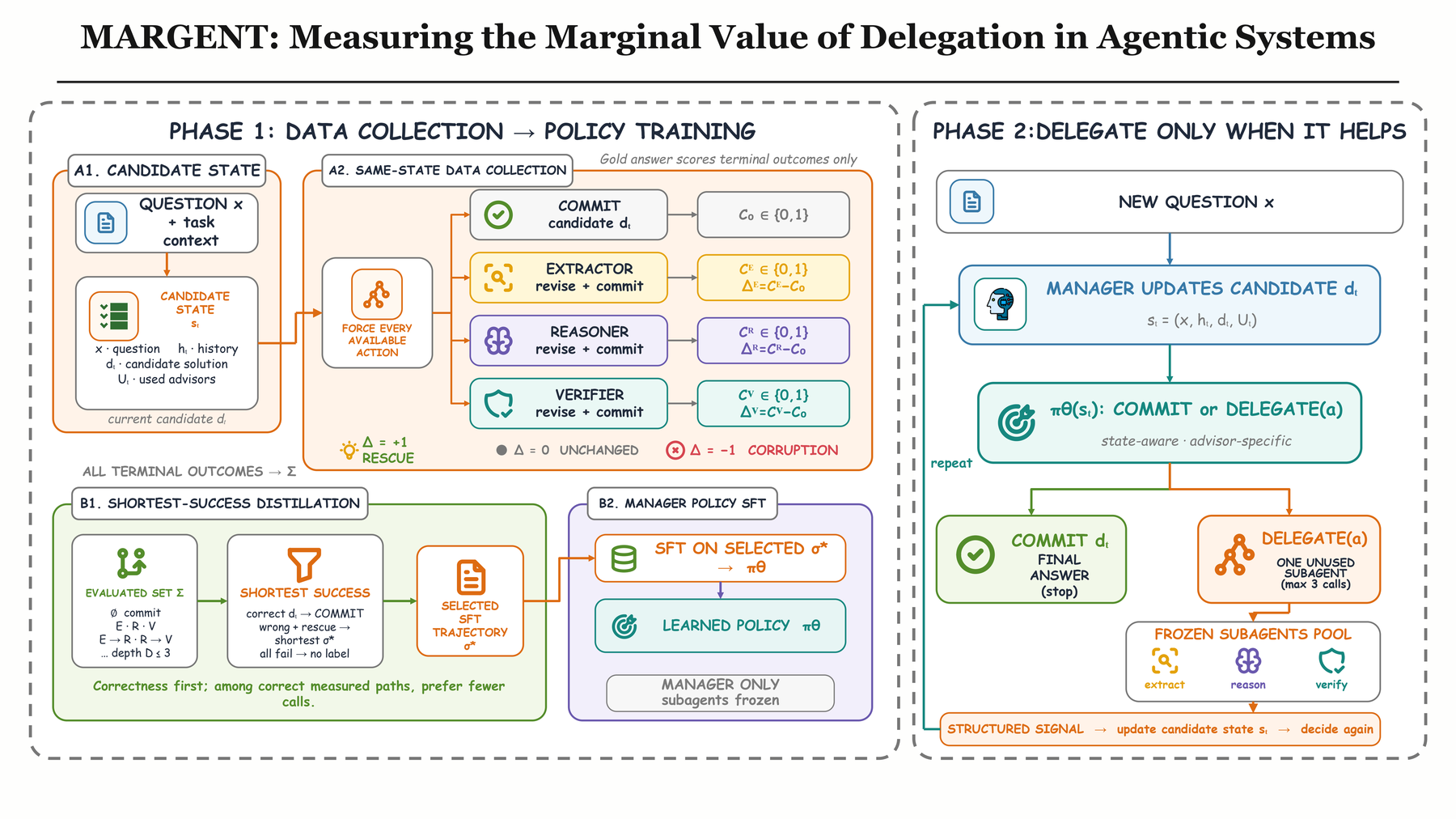
The delegate-or-commit interface
For a question x, the state at turn t is st = (x, ht, ŷt, Ut): the question, the interaction history, the manager's current candidate solution and the set of sub-agents already used. The manager picks one action from Eq. 1; a commit submits ŷt and ends the trajectory, while a delegation appends the chosen sub-agent's output to the history, after which the manager revises its candidate and chooses again.
| Sub-agent | What it returns | What it receives |
|---|---|---|
| Extractor | Decision-relevant facts and their polarity | Question and context |
| Reasoner | A decomposition of the problem and the missing reasoning steps | Question and context |
| Verifier | An audit of the current candidate solution | Question, context, and the manager's current candidate |
Invariants
- Sub-agents are frozen. Only the manager is trained.
- Sub-agents emit structured signals, never a choice label or final answer; the Verifier additionally receives the manager's current candidate as input.
- Each sub-agent can be called at most once, so a trajectory has at most three delegations, and the manager owns both candidate revision and the final commitment.
MARGENT
(a) Interventional marginal-value measurement
C(st, commit) says whether committing the current candidate is correct, and C(st, delegate(a)) is the correctness of a branch that forces one delegation to a, lets the manager revise, and then commits without further delegation. +1 is a rescue, 0 means no change and −1 is a corruption; the value measures the whole call-revise-commit operation under the fixed revision protocol, not the intrinsic capability of the sub-agent.
- A temperature-zero manager produces the root candidate without delegation; from that shared root the collector forces direct commitment and delegation to every sub-agent.
- Search is breadth-first over ordered sequences of distinct sub-agents to a maximum depth D ≤ 3; for a wrong root it stops after the first depth that contains a success and keeps all equally short successes.
- For a correct root only one-step delegations are evaluated, kept for corruption analysis; the gold answer scores terminal branches only and is never shown to the manager or the sub-agents.
(b) Marginal-value distillation
| Root candidate | Measured branches | Supervision target |
|---|---|---|
| Correct | One-step branches only, kept for corruption analysis | Commit immediately (ε) |
| Wrong, first success at depth d | Search stops at depth d; all successes at that depth are kept | One of the shortest successes, sampled with a fixed example seed: d calls, then commit |
| Wrong, no success to depth D | Every layer evaluated, none succeeds | No label (Σ* = ∅): the state teaches neither commit nor delegate |
Commit trajectories are capped at ρ times the number of rescue trajectories, where ρ is a data-construction hyperparameter, and SFT updates the full manager, so candidate-to-final gains are end-to-end effects rather than routing-only effects.
The rule imposes a lexicographic preference over measured successful trajectories: correctness first, then fewer delegations. A scalarized per-call penalty needs a task-dependent exchange rate between accuracy and calls; the trajectory target needs none, and ρ still controls how much direct-commit supervision is kept.
Experimental setup
| Item | Value |
|---|---|
| Benchmarks | MedQA (medical), MMLU-Pro (broad knowledge), GPQA (scientific), AQuA-RAT (mathematical); all multiple-choice |
| Interventional collections | 400 root states per task; GPQA 200 |
| Development pools and locked evaluations | Development pools: MedQA 200, MMLU-Pro 200, AQuA-RAT 254, GPQA 100. Locked evaluations, one run each after fixing depth, ρ and checkpoint: MedQA 500, MMLU-Pro 500, AQuA-RAT 254. GPQA-Diamond-100 is disjoint from the GPQA collection but also serves as its development pool |
| Manager and sub-agents | Qwen3.5-9B manager, the only trained component; three frozen role-specific LoRA sub-agents on the same model family |
| Decoding | Greedy for interventional probes and sub-agent calls |
| Search depth | 3 for MedQA and AQuA-RAT; 2 for the primary MMLU-Pro and GPQA collections |
| ρ sweep | {0, 0.5, 1, 2, 3}. ρ = 0 keeps only rescue states and those policies delegate on nearly every question; larger ρ keeps more states in which committing was already correct |
| Comparisons | (i) the policy's own candidate before any delegation; (ii) one forced Verifier call; (iii) all three sub-agents forced in the recorded scaffold order; (iv) the measured oracle, best evaluated sequence per example |
| Metrics | Exact-match multiple-choice accuracy; mean sub-agent calls per example; rescue/correction and corruption probabilities from paired outcomes |
Results
5aHow much value is available after one delegation?
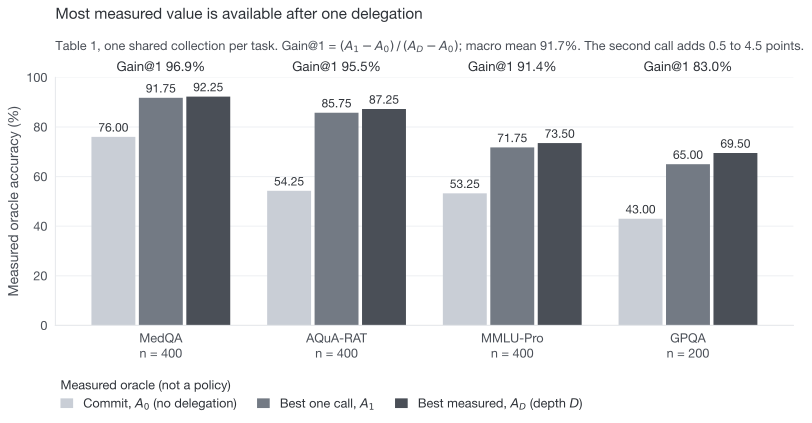
| Task | n | Commit A0 | Best 1 call A1 | Best measured AD | Gain@1 |
|---|---|---|---|---|---|
| MedQA | 400 | 76.00 | 91.75 | 92.25 | 96.9% |
| AQuA-RAT | 400 | 54.25 | 85.75 | 87.25 | 95.5% |
| MMLU-Pro | 400 | 53.25 | 71.75 | 73.50 | 91.4% |
| GPQA | 200 | 43.00 | 65.00 | 69.50 | 83.0% |
| Macro mean | – | 56.63 | 78.56 | 80.63 | 91.7% |
Most of the recoverable value sits in the first well-chosen delegation: one call recovers over 90% of the measured gain on three tasks and 91.7% in the macro mean. A second call adds 0.5 to 4.5 points and the third adds zero on the two collections searched to depth three; GPQA, whose commit accuracy is closest to chance, gains the most from a second call (4.5 points).
5bThe value of a call depends on which sub-agent is called
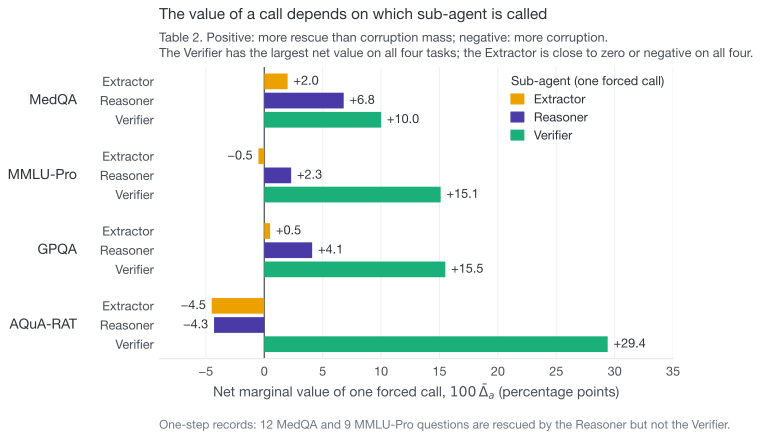
| Task | Extractor | Reasoner | Verifier |
|---|---|---|---|
| MedQA | +2.0 | +6.8 | +10.0 |
| MMLU-Pro | −0.5 | +2.3 | +15.1 |
| GPQA | +0.5 | +4.1 | +15.5 |
| AQuA-RAT | −4.5 | −4.3 | +29.4 |
The same Reasoner is worth +6.8 points on MedQA and −4.3 on AQuA-RAT, and the Extractor is near zero or negative on all four tasks. The Verifier has the largest mean value everywhere but is not interchangeable: 12 MedQA and 9 MMLU-Pro questions are rescued by the Reasoner and not by the Verifier, and forcing the strongest role on every question still spends calls on already-correct candidates.
5cLearned delegation on collection-disjoint evaluations
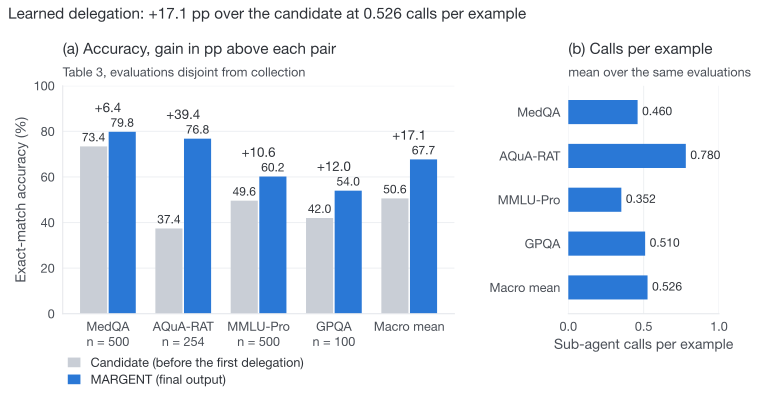
| Task | n | Candidate | MARGENT | Gain (pp) | Calls |
|---|---|---|---|---|---|
| MedQA | 500 | 73.4 | 79.8 | +6.4 | 0.460 |
| AQuA-RAT | 254 | 37.4 | 76.8 | +39.4 | 0.780 |
| MMLU-Pro | 500 | 49.6 | 60.2 | +10.6 | 0.352 |
| GPQA | 100 | 42.0 | 54.0 | +12.0 | 0.510 |
| Macro mean | – | 50.6 | 67.7 | +17.1 | 0.526 |
MARGENT's final answer is more accurate than the same trained manager's pre-delegation candidate on all four tasks, by 17.1 points in the macro mean at 0.53 calls per example. Checkpoints for MedQA, MMLU-Pro and AQuA-RAT were fixed before this single run; GPQA-Diamond-100 is collection-disjoint but also served as its development pool.
SFT updates the full manager, so Table 3 is an end-to-end difference inside the same scaffold, not a routing-only effect or a gain over an independently prompted single model; on AQuA-RAT the tool-enabled scaffold's candidate is much weaker than a plain-answer prompt.
5dFewer calls at the same accuracy
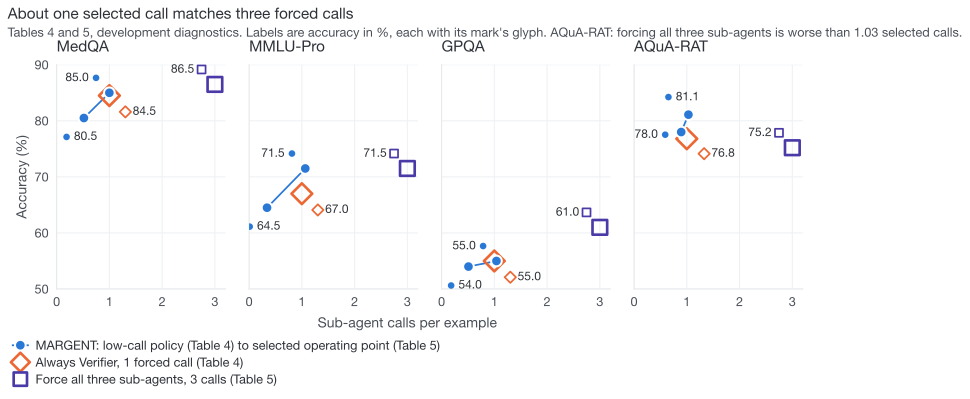
| Task | Selected MARGENT acc. | Calls | Force all acc. | Calls | ΔAcc. (selected − force all) |
|---|---|---|---|---|---|
| MedQA | 85.0 | 1.000 | 86.5 | 3.0 | −1.5 |
| MMLU-Pro | 71.5 | 1.065 | 71.5 | 3.0 | 0.0 |
| GPQA | 55.0 | 1.040 | 61.0 | 3.0 | −6.0 |
| AQuA-RAT | 81.1 | 1.031 | 75.2 | 3.0 | +5.9 |
| Macro mean | 73.2 | 1.034 | 73.6 | 3.0 | −0.4 |
At about one selected call per example, MARGENT averages 73.2% at 1.03 calls against 73.6% at 3.0 calls for forcing all three sub-agents; MMLU-Pro matches at 71.5% (1.07 vs 3 calls), AQuA-RAT is 5.9 points better (81.1% vs 75.2%) and GPQA stays 6.0 points worse. On the same development pools, low-call MARGENT policies save 43.5% of calls against forcing one Verifier call on every example for about 1.6 accuracy points (Table 4, development diagnostic). That forced-Verifier baseline did not receive the candidate, so it is a strong operational baseline rather than a matched routing ablation.
5eDoes the policy call on the right states? development diagnostic
For analysis only, gold labels give the call gap (the probability of delegating when the candidate is wrong minus the probability when it is correct), which is positive on all four tasks at the selected development operating points: 0.381 on MedQA, 0.296 on MMLU-Pro, 0.067 on GPQA and 0.102 on AQuA-RAT. A matched-budget replay that fixes the role and call count and resamples examples 2,000 times puts MedQA's selected subset at 82.0%, above the random 95% interval [75.0, 81.0], with MMLU-Pro and GPQA inside their intervals, although this test does not isolate candidate use from query difficulty.
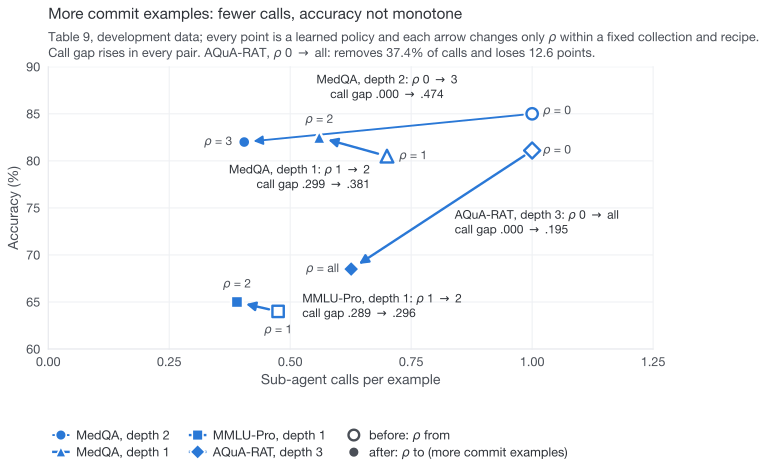
| Task / collection | ρ | Accuracy | Calls | Call gap |
|---|---|---|---|---|
| MedQA depth 2 | 0 → 3 | 85.0 → 82.0 | 1.000 → 0.405 | .000 → .474 |
| MedQA depth 1 | 1 → 2 | 80.5 → 82.5 | .700 → .560 | .299 → .381 |
| MMLU-Pro depth 1 | 1 → 2 | 64.0 → 65.0 | .475 → .390 | .289 → .296 |
| AQuA-RAT depth 3 | 0 → all | 81.1 → 68.5 | 1.000 → .626 | .000 → .195 |
Keeping more commit examples lowers the call rate in every pair and generally raises the call gap, but accuracy is not monotone: the aggressive AQuA-RAT comparison removes 37.4% of calls and loses 12.6 points, so ρ is a transparent control over policy behaviour, not a free efficiency gain.
5fDoes the candidate matter to a delegated call?
| Metric | With candidate | Candidate blanked |
|---|---|---|
| Accuracy | 81.1% | 74.0% |
| Correction (fraction of all examples) | 0.480 | 0.409 |
| Corruption (fraction of all examples) | 0.0240 | 0.0236 |
Blanking the candidate lowers accuracy from 81.1% to 74.0% and correction from 0.480 to 0.409 while corruption is essentially unchanged, so the candidate is a useful audit target for a delegated call; routing was fixed in this run, so the ablation does not show that the router uses the candidate when deciding whether to call.
Appendix diagnostics
| Run | Calls | Accuracy | Observed behaviour |
|---|---|---|---|
| MedQA, 8B manager | 2.98 | – | Approaches the three-call ceiling |
| MedQA, 9B manager | 3.00 | – | Three calls on every example; the solution is emitted late |
Outcome-only GRPO continuations collapse to the three-call ceiling, 2.98 and 3.00 calls per example. Accuracy records for these two runs are missing from the exported record, so the appendix supports a claim about call behaviour only; for reference, one fixed MedQA SFT configuration with three extra seeds gives 80.5 ± 1.0 accuracy at 0.517 ± 0.043 calls.